Why Americans Stopped Trusting Washington
Only 17% of Americans trust the federal government most of the time. Why trust collapsed under both parties, and what would earn it back.

In 1964, about three out of four Americans said they trusted the federal government to do what is right just about always or most of the time. A Pew Research Center report published in December 2025, based on a September 2025 survey, put that number at 17 percent. Pew Research Center calls it one of the lowest readings in nearly seven decades of asking the question.
That isn't a mood. It's a long verdict, delivered by Americans of every party, about how the system has treated them.
Not a Partisan Number
It's tempting to read the trust numbers as a scoreboard. When your party is in the White House, you trust Washington a bit more. When the other side is in, you trust it less. Pew's data shows exactly that swing. Republicans' trust rose after the 2024 election, and Democrats' trust fell to the lowest Pew has ever measured for them.
But look at the long line instead of the wiggles, and the trend runs one way. Trust has rarely topped 30 percent since the mid-2000s, under presidents from both parties. A generation of Americans has never known anything else. Changing who's in charge hasn't fixed it, because the problem isn't one party. It's the system both of them operate.

What People Are Reacting To
Ask people why they don't trust Washington, and you rarely hear about tax rates or treaty details. You hear things like this:
- "They work for donors, not us." Elections now cost billions, and a record share of outside money comes from groups that hide their donors. We covered that in Dark Money.
- "They get rich in office." Members of Congress trade individual stocks in industries they regulate. When dozens fail to report trades on time, the penalty is often $200. See Congress Shouldn't Be Trading Stocks.
- "They cash out when they leave." Most former lawmakers who take jobs outside politics go to work influencing their old colleagues. See The Revolving Door.
- "Nothing changes no matter who I vote for." In most House districts, the November election is decided before it starts, a problem we explained in Gerrymandering.
Every one of those complaints is about the same thing: a government that feels like it's for sale. That's why we think corruption, not left versus right, is the real dividing line in American politics.
Distrust Can Go Two Ways
Low trust is dangerous. A country that doesn't believe its institutions is easier to divide, easier to scare, and easier to sell a strongman. People who give up on government entirely often stop voting, which leaves the field to the very insiders they distrust.
But the founders weren't trusting people either. The Declaration of Independence is, among other things, a long list of reasons not to trust a government. Their answer wasn't to give up. It was to build a system where power was checked, officials answered to voters, and citizens stayed alert.
Madison put it simply in Federalist No. 51: "If men were angels, no government would be necessary." Since they're not, he wrote, government has to be designed so it can control itself, with "a dependence on the people" as "the primary control."
So healthy distrust isn't cynicism. It's vigilance. It asks, "who benefits?" and then does something about the answer.

Earning It Back
Trust can't be demanded. It has to be earned, and it would take specific, visible changes:
- Ban stock trading by members of Congress and their families.
- Shut the revolving door with long cooling-off periods and no "consultant" loophole.
- Require real donor disclosure for anyone spending to influence an election.
- Take map-drawing away from politicians and give it to independent citizen commissions.
- Let voters choose freely, through open primaries or ranked-choice voting, so people aren't stuck picking the lesser evil.
None of these belong to one party. Most of them poll well with voters in both. They stall because the people who'd have to pass them are the ones who benefit from the current rules. That's what we mean when we say neither party will save you.
Where to Start
Rebuilding trust in self-government starts with practicing it. Show up to the local meetings most people skip. Ask your representatives direct questions and write down the answers. Read the disclosure reports. Talk to the neighbor who disagrees with you on everything except this. We pulled a lot of those ideas together in Common Sense, 250 Years On.
The government in Washington isn't the country. The country is the people who live in it. If the people in charge have forgotten that, it's up to the rest of us to remind them, peacefully and constantly.
Wear It
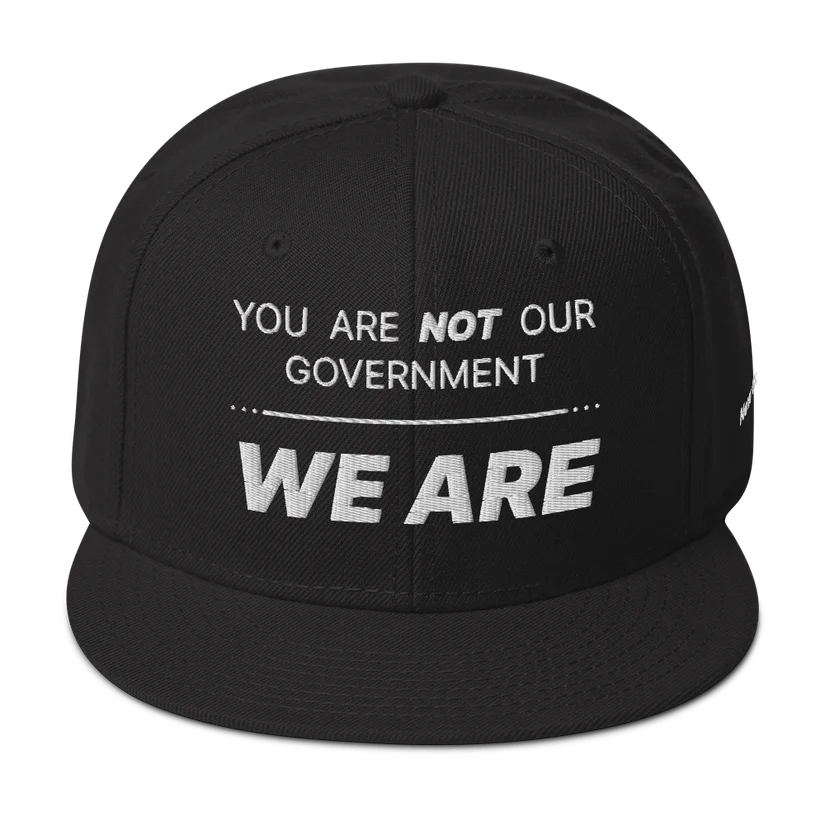
That's the line on our most direct hat: You are not our government, WE ARE. It isn't anti-government. It's a reminder of who the government is supposed to be.
On WeWrite we keep a page for the slogan, You are not our government, WE ARE, and a short page on what New Continent is. The full line is on our merch designs page.
Shop the Hat
Remind them who's in charge. You are not our government, WE ARE snapbackMade on demand. Checkout on Printful.
Sources
- Pew Research Center, "Public Trust in Government: 1958-2025," published Dec. 4, 2025, based on a September 2025 survey: https://www.pewresearch.org/politics/2025/12/04/public-trust-in-government-1958-2025/
- James Madison, Federalist No. 51 (1788), Avalon Project: https://avalon.law.yale.edu/18th_century/fed51.asp
- The Declaration of Independence, transcript (National Archives): https://www.archives.gov/founding-docs/declaration-transcript
Shop the hat
Keep reading
November 7, 2026
The Right to Petition: Lobbying Was Supposed to Be Yours
The First Amendment protects your right to petition the government. How it got professionalized, and how ordinary citizens can use it well.
November 7, 2026
The Elections Nobody Shows Up For
In some big cities, fewer than 1 in 10 people vote for mayor. Why local elections matter more than you think, and a simple plan to show up.
November 7, 2026
Who Lobbies for Foreign Governments in Washington?
Foreign agents reported more than $1.1 billion in 2024. What FARA requires, where it falls short, and why Washington warned about foreign influence.