Dark Money: You Can't Hold Accountable What You Can't See
Dark money hit a record $1.9 billion in 2024 federal races. Where it comes from, how it hides, and what disclosure would fix.
Here's a fair question to ask about any political ad: who paid for it?
For a growing share of the money in American elections, the honest answer is "we don't know." That's what people mean by dark money: political spending by groups that aren't required to say where their money came from. It isn't a conspiracy theory. It's a line item, and it keeps getting bigger.
How Big It Got
The Brennan Center for Justice, a nonpartisan law and policy institute, estimated that dark money groups put more than $1.9 billion into the 2024 federal elections, nearly double the previous record of about $1 billion in 2020. By its count, dark money groups have spent at least $4.3 billion on federal elections since 2010. The Brennan Center says its 2024 figure is conservative, because some kinds of undisclosed spending can't be tracked at all.
OpenSecrets, which follows money in politics, reported that outside spending on the 2024 federal elections hit a record $4.5 billion, and that super PACs reported receiving over $1 billion from shell companies and dark money nonprofits that don't disclose their donors. In 2016, the same kind of contributions came to less than $71.7 million.
Both parties' allies do this. OpenSecrets reported that one Senate Democratic group alone accounted for over $113 million, and Republican-aligned groups play the same game. The tool doesn't care who uses it.
How the Money Goes Dark
The mechanics are simple once you see them.
A super PAC can raise and spend unlimited sums, but it has to report its donors to the Federal Election Commission. So instead of giving directly, a wealthy donor or a corporation gives to a nonprofit, often a 501(c)(4) "social welfare" group, which doesn't have to name its donors. The nonprofit then gives to the super PAC. The super PAC's report lists the nonprofit's name. The original donor disappears.
Sometimes the middleman is a freshly formed LLC with a post office box. Sometimes the money buys ads that never mention voting for anyone, so they fall outside federal reporting entirely. Either way, you see the commercial, and you have no idea who is talking.
Citizens United Promised Transparency
In 2010, the Supreme Court's decision in Citizens United v. FEC allowed corporations and unions to spend unlimited amounts on independent political advocacy. A big part of the Court's reasoning was that disclosure would keep it honest. Justice Kennedy's majority opinion said that "prompt disclosure of expenditures can provide shareholders and citizens with the information needed to hold corporations and elected officials accountable."
The disclosure never really arrived. As the Brennan Center puts it, many of the groups the Court allowed to spend weren't required to name their donors. Unlimited money plus missing disclosure is how we got to $1.9 billion.
We laid out the broader case for limiting money in campaigns in How to Get Money Out of Politics. Dark money is the part even many people who defend big political spending should be able to agree on: if you're spending to change an election, voters deserve to know your name.
Why Anonymity Matters Here
There is a real tradition of anonymous political speech in America. Common Sense was first published without Paine's name on it. The Federalist Papers were signed "Publius." Nobody should have to give their home address to hand out a pamphlet.
But a person writing an essay is not the same as a nine-figure ad budget. Paine's argument stood or fell on what it said. A dark money ad campaign works because you can't weigh the speaker's interest against the message. If an ad about drug prices is paid for by drug companies, you'd want to know. That's the whole point of hiding it.
And once the election is over, the officeholder knows exactly who helped. The only people kept in the dark are the voters. That's backward.
What Would Fix It
- Follow the money to its source. Any group spending above a modest threshold on election ads should disclose its significant donors, including the original source of money passed through other groups.
- Close the "it's just an issue ad" loophole for ads that name a candidate close to an election.
- Require the top funders on screen. Several states already require ads to show their largest donors. Federal elections should too.
- Fund the referee. The FEC is often deadlocked and slow. Enforcement that arrives years after an election doesn't protect anyone.
None of these ban anyone from speaking. They just require the speaker to stand in the light.
What You Can Do
When you see a political ad from a group with a name like "Americans for a Better Tomorrow," look it up on OpenSecrets before you believe it. Share what you find. Ask your candidates whether they'll support donor disclosure, even when it hurts their own side. If they hedge, you've learned something.
Wear It
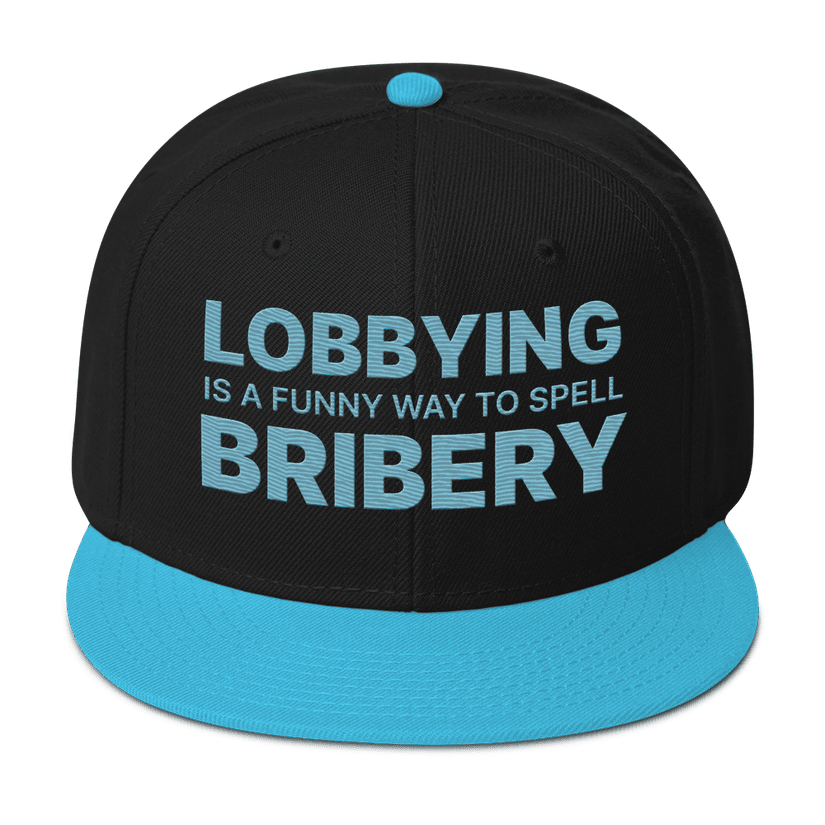
Our tropical cap takes the edge off a pretty grim subject: Lobbying is a funny way to spell BRIBERY. Dark money and lobbying are two doors into the same room, where people with money get heard and people without it get ads.
On WeWrite we keep a short page for the slogan, Lobbying is a funny way to spell Bribery, and a page on the Spirit of 1776, the idea behind our tagline.
Shop the Hat
Bright cap, dark subject. Lobbying is a funny way to spell BRIBERY, tropical snapbackMade on demand. Checkout on Printful.
Sources
- Brennan Center for Justice, "Dark Money Hit a Record High of $1.9 Billion in 2024 Federal Races": https://www.brennancenter.org/our-work/research-reports/dark-money-hit-record-high-19-billion-2024-federal-races
- OpenSecrets, "Outside spending on 2024 elections shatters records, fueled by billion-dollar 'dark money' infusion" (Nov. 2024): https://www.opensecrets.org/news/2024/11/outside-spending-on-2024-elections-shatters-records-fueled-by-billion-dollar-dark-money-infusion/
- Citizens United v. Federal Election Commission, 558 U.S. 310 (2010), Oyez: https://www.oyez.org/cases/2008/08-205
- Opinion text, Cornell LII: https://www.law.cornell.edu/supct/html/08-205.ZO.html
- OpenSecrets dark money tracker: https://www.opensecrets.org/dark-money
Shop the hat
Keep reading
November 7, 2026
Why Americans Stopped Trusting Washington
Only 17% of Americans trust the federal government most of the time. Why trust collapsed under both parties, and what would earn it back.
November 7, 2026
The Right to Petition: Lobbying Was Supposed to Be Yours
The First Amendment protects your right to petition the government. How it got professionalized, and how ordinary citizens can use it well.
November 7, 2026
The Elections Nobody Shows Up For
In some big cities, fewer than 1 in 10 people vote for mayor. Why local elections matter more than you think, and a simple plan to show up.