The Right to Petition: Lobbying Was Supposed to Be Yours
The First Amendment protects your right to petition the government. How it got professionalized, and how ordinary citizens can use it well.

The First Amendment is famous for speech, religion, and the press. Its last clause gets less attention, but it may be the one that matters most for how Washington works today. It protects "the right of the people peaceably to assemble, and to petition the Government for a redress of grievances."
That's lobbying. The original kind. Any citizen, walking up to the government and asking it to fix something.
Somewhere along the way, that right got professionalized, and most Americans got priced out.
Where the Right Came From
The right to petition is older than the country. It goes back to English law, including the English Bill of Rights of 1689, which declared "it is the right of the subjects to petition the king."
The colonists used it heavily. The Declaration of Independence lists the king's offenses and then says: "In every stage of these Oppressions We have Petitioned for Redress in the most humble terms: Our repeated Petitions have been answered only by repeated injury." In other words, one of the reasons for the Revolution was that the government stopped listening to petitions.
When the First Congress wrote the Bill of Rights, it put petition right next to speech, press, and assembly.

What Happened to It
The right hasn't changed. What changed is who can afford to use it well.
A lobbying firm on K Street can put a former congressional staffer in front of a committee chairman this week. It can draft the bill language, organize the "grassroots" calls, and host the fundraiser where the real conversation happens. That's petitioning too, legally speaking. Lobbyists often point to the First Amendment to defend their work, and they're not wrong that it protects them.
But when a right can only be exercised effectively by people with money, it starts to work like a privilege. A retired teacher who drives to her state capitol to ask for a meeting is exercising the same right as a corporation with a dozen registered lobbyists. Guess whose meeting gets scheduled.
We've made the case that the system has gone too far in Lobbying Is a Funny Way to Spell Bribery and The Case Against Lobbying, Made Plainly. This post is about the other half: taking the right back.
Petitioning Still Works
Here's what professional lobbyists know and most citizens don't: congressional offices do pay attention to constituents. Especially personal, specific ones.
The Congressional Management Foundation, a nonpartisan group that works with congressional offices, has surveyed staff for years about what influences undecided lawmakers. Its 2017 report, drawing on staff surveys going back to 2004, found that more than 90 percent of staffers said in-person visits from constituents had some or a lot of influence on an undecided lawmaker. Personal, specific messages beat form letters and mass campaigns. A real person from the district, with a real story, gets noticed.
That's the opening. You can't outspend K Street. But you're something K Street can never be: a voter who lives there.

How to Petition Like a Pro
- Pick one issue. Lawmakers get a flood of requests. One clear ask beats ten general complaints.
- Make it personal. Explain how the issue affects you, your work, your family, your town. Specifics stick.
- Write your own words. A short, original email or letter beats a pre-written form message.
- Ask for a meeting. Members hold office hours and staff meetings in their home districts, not just in Washington. Call the district office and ask. A meeting with a staffer is not a brush-off. Staff often shape the decision.
- Show up at town halls. Ask a specific question in public. Be polite and firm.
- Bring friends. Five constituents asking for the same thing is a pattern, not an anecdote.
- Follow up. Send a thank-you, then check how they voted. Remind them you noticed.
None of this needs a lobbying license or a donation. It needs an hour and a little nerve.
Assembly Goes With It
The same clause protects the right to assemble. Petitioning gets stronger when people do it together: a neighborhood group, a church committee, a parents' group, a few coworkers. That's how this country has always pushed its government, from colonial town meetings to the present. We wrote about what that spirit looks like now in The Spirit of '76, Still Fitting.
Take It Back
The founders didn't write "the right of registered lobbyists to petition." They wrote "the people." The answer to a captured system isn't to give up on asking. It's to ask louder, more often, and in larger numbers, until the people's petitions are harder to ignore than the paid ones.
Wear It
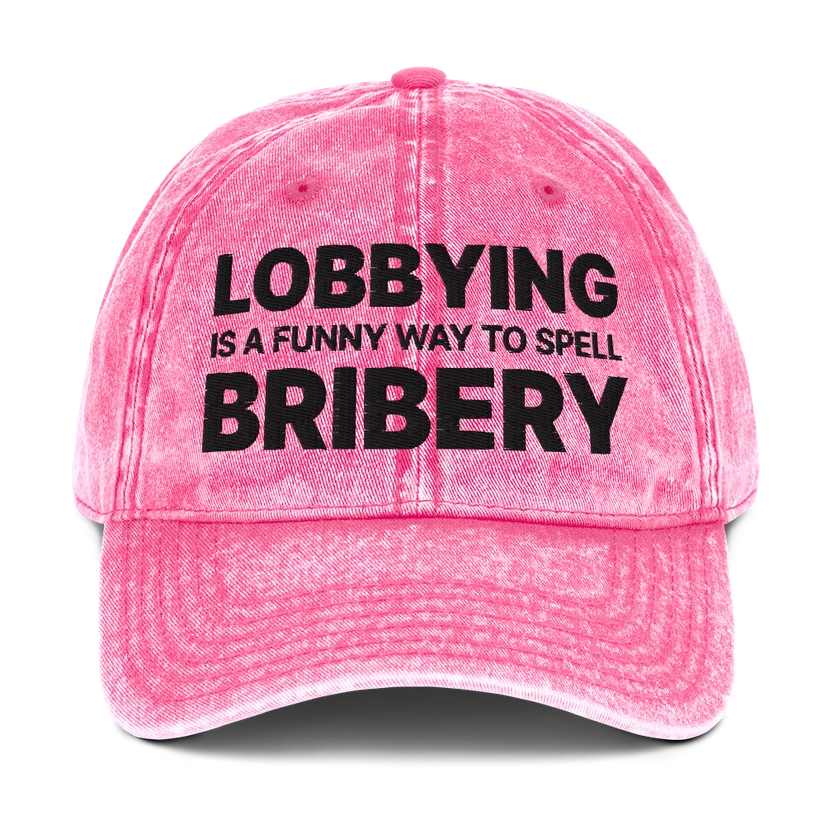
Our pink dad cap says what a lot of people quietly think about the professional version: Lobbying is a funny way to spell BRIBERY. Wear it to the town hall. It makes the point before you open your mouth.
On WeWrite we keep a short page for the slogan, Lobbying is a funny way to spell Bribery, and a page on the Spirit of 1776.
Shop the Hat
The people's lobby. Lobbying is a funny way to spell BRIBERY, pink dad capMade on demand. Checkout on Printful.
Sources
- The Bill of Rights, transcript (National Archives): https://www.archives.gov/founding-docs/bill-of-rights-transcript
- The Declaration of Independence, transcript (National Archives): https://www.archives.gov/founding-docs/declaration-transcript
- English Bill of Rights (1689), Avalon Project: https://avalon.law.yale.edu/17th_century/england.asp
- Roll Call, "Report Shows 'Untapped Power' of Constituent Advocacy" (Feb. 13, 2017), on the Congressional Management Foundation's staff surveys: https://rollcall.com/2017/02/13/report-shows-untapped-power-of-constituent-advocacy/
- Congressional Management Foundation: https://www.congressfoundation.org/
Shop the hat
Keep reading
November 7, 2026
Why Americans Stopped Trusting Washington
Only 17% of Americans trust the federal government most of the time. Why trust collapsed under both parties, and what would earn it back.
November 7, 2026
The Elections Nobody Shows Up For
In some big cities, fewer than 1 in 10 people vote for mayor. Why local elections matter more than you think, and a simple plan to show up.
November 7, 2026
Who Lobbies for Foreign Governments in Washington?
Foreign agents reported more than $1.1 billion in 2024. What FARA requires, where it falls short, and why Washington warned about foreign influence.