Lobbying Is a Funny Way to Spell Bribery
Why we call lobbying a funny way to spell bribery, what the law says, and why the founders would wear the hat. A plain case for citizens.

In January of 1776, a pamphlet appeared in Philadelphia whose author promised his readers "nothing more than simple facts, plain arguments, and common sense." Thomas Paine did not ask permission to say what everyone half-knew. He said it, and a continent changed its mind.
We make hats, not pamphlets. But we hold to the same method. One of our hats says a thing many Americans already suspect and few in Washington will say aloud: Lobbying is a funny way to spell BRIBERY. This post explains why we put those words on a cap, what we mean by them, and what we do not mean.
A Slogan Is an Argument Folded Small
A slogan is not a legal brief, and we do not pretend it is one. Under federal law, bribery has a precise meaning. The bribery statute, 18 U.S.C. § 201, makes it a crime when anyone "directly or indirectly, corruptly gives, offers or promises anything of value to any public official" with intent to influence an official act. Proving that takes a corrupt intent and, in practice, something very close to an explicit exchange.
Lobbying, by contrast, is legal. It is registered and reported under the Lobbying Disclosure Act of 1995, and the filings sit in public databases kept by the House and Senate.
So why the hat? Because a thing can be lawful and still be wrong. A system can be built so that what would be a crime in a single envelope becomes respectable when spread across a fundraiser, a campaign committee, a job offer after office, and a thousand meetings ordinary citizens will never get. The slogan is a joke with a point: if you need a lawyer to explain why it isn't bribery, the people have a right to ask why it is allowed.

The Right to Petition Is Ours, Not for Sale
Let us be fair, as Paine was not always fair to his opponents. The First Amendment protects "the right of the people peaceably to assemble, and to petition the Government for a redress of grievances." Every American may write to a representative, march, testify, or band together with neighbors to press a cause. That is not corruption. That is citizenship.
The trouble begins when petitioning becomes a profession, and the profession becomes a marketplace. The farmer, the nurse, and the shopkeeper petition with a letter. The well-funded interest petitions with a permanent staff, a political committee, and the quiet promise of support at election time. Both are called "lobbying." Only one of them sounds like a republic.
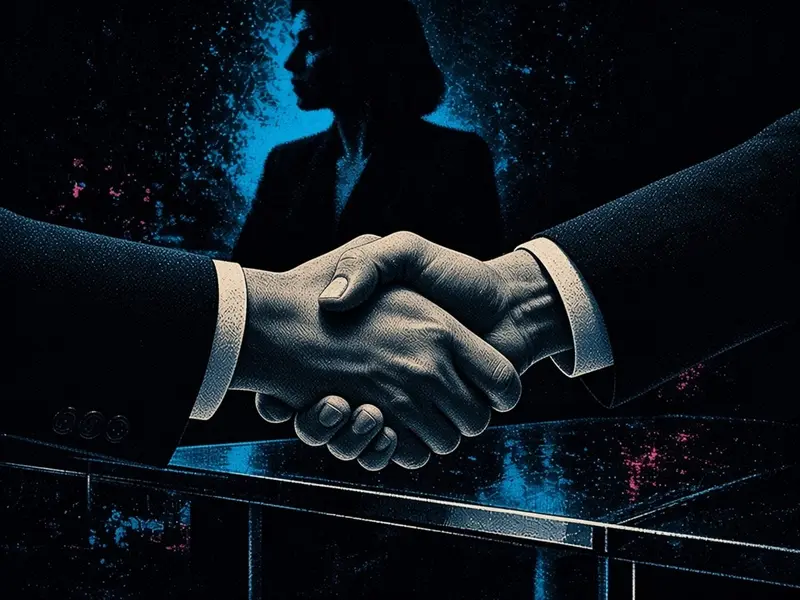
What the Founders Feared
The men of 1776 and 1787 did not use our modern word, but they knew the danger well. In Federalist No. 57, the authors wrote that "the aim of every political constitution is, or ought to be, first to obtain for rulers men who possess most wisdom to discern, and most virtue to pursue, the common good of the society; and in the next place, to take the most effectual precautions for keeping them virtuous whilst they continue to hold their public trust."
Read that last clause again: keeping them virtuous whilst they continue to hold their public trust. The founders did not assume good men would stay good. They built precautions. Ask yourself whether our present arrangements keep representatives virtuous, or simply keep them funded.
Madison, in Federalist No. 51, put the principle more sharply still: "If men were angels, no government would be necessary." Neither lobbyists nor lawmakers are angels. Neither are we. That is precisely why the rules matter. (We take up the founders' warnings in more depth in What the Founders Said About Corruption.)
Neither Party Has Clean Hands
Here is where we part company with nearly every political brand in America. We do not sell this hat to one team so they can wave it at the other. The lobbying industry does not care which party holds the gavel; it hires from both and gives to both. A slogan that only ever points across the aisle is not a principle. It is a uniform.
Washington, in his Farewell Address, warned "in the most solemn manner against the baneful effects of the spirit of party generally." Generally. Not one party. The spirit itself. If you believe your side is the honest one, wear the hat to your own side's events first. That is where it will do the most good. We make that case at length in Neither Party Will Save You.

Four Colors, One Conviction
We make the Lobbying hat in four colorways, because conviction need not be drab.
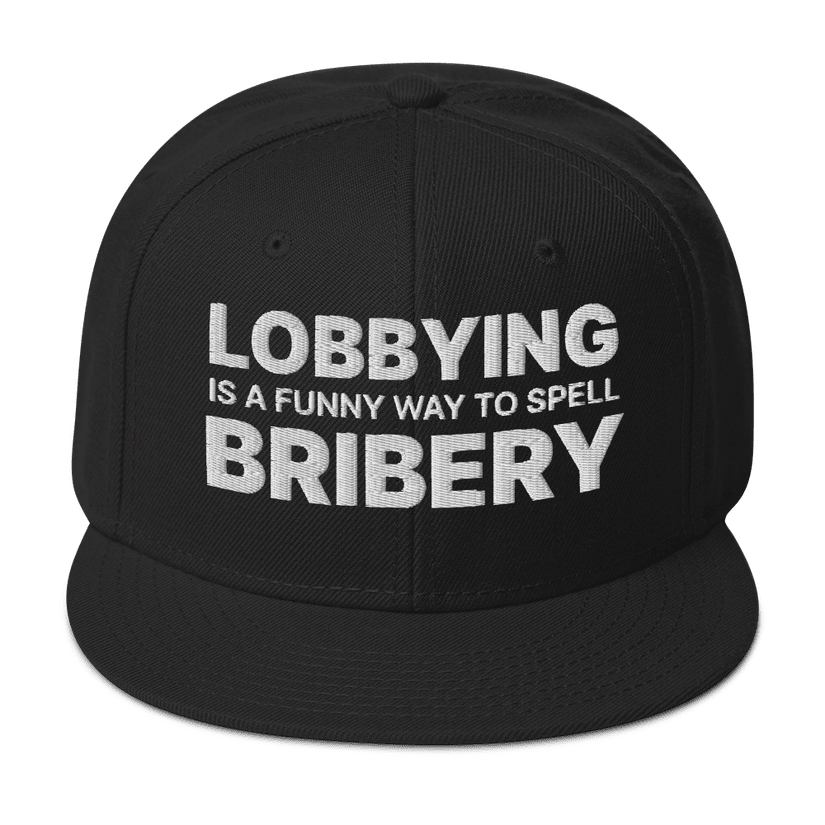
- Black. The original. Our black Lobbying is a funny way to spell BRIBERY snapback is described on its page as "structured and high-profile, with a flat visor and a subtle grey under visor." Or, as we put it: K Street won't like this one.
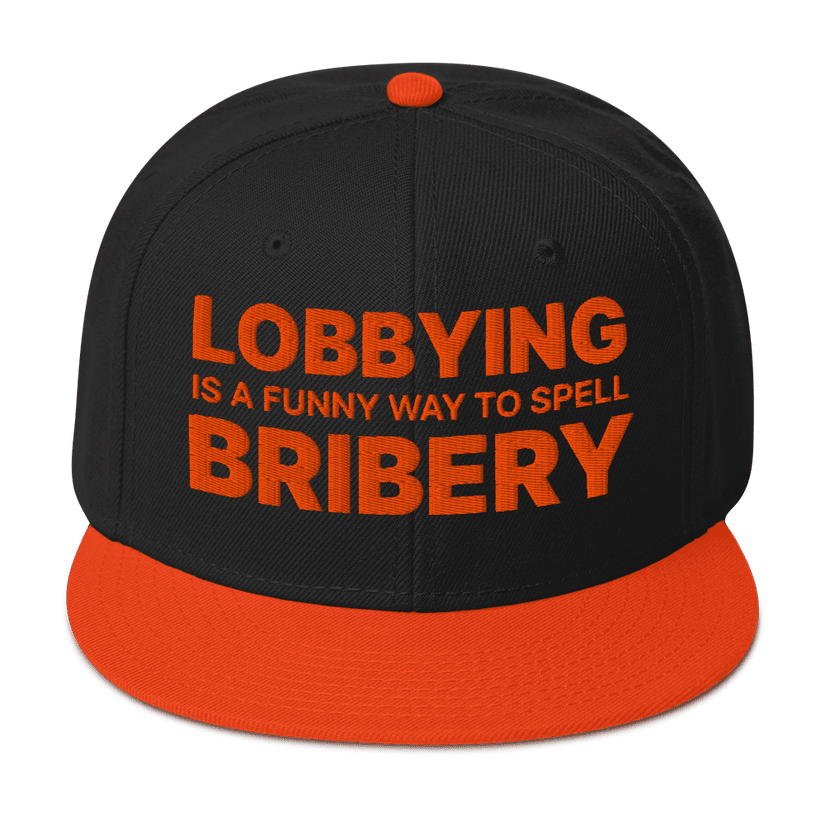
- Orange. The orange Lobbying / BRIBERY snapback. Orange is the new green.
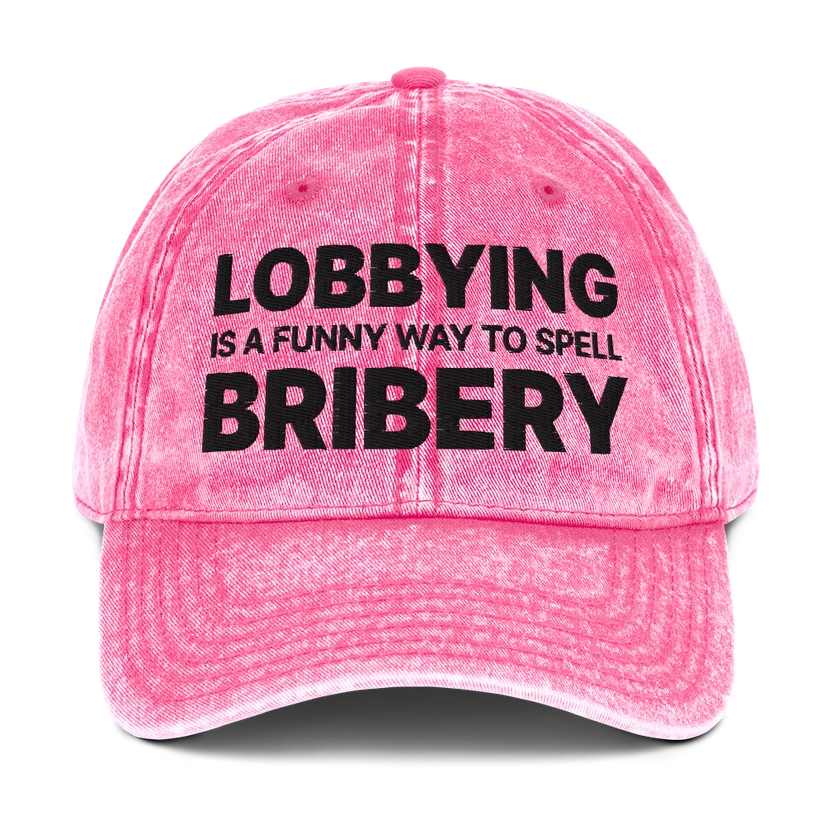
- Pink. The pink Lobbying / BRIBERY dad cap, for those who prefer a softer shape and a sharp message.
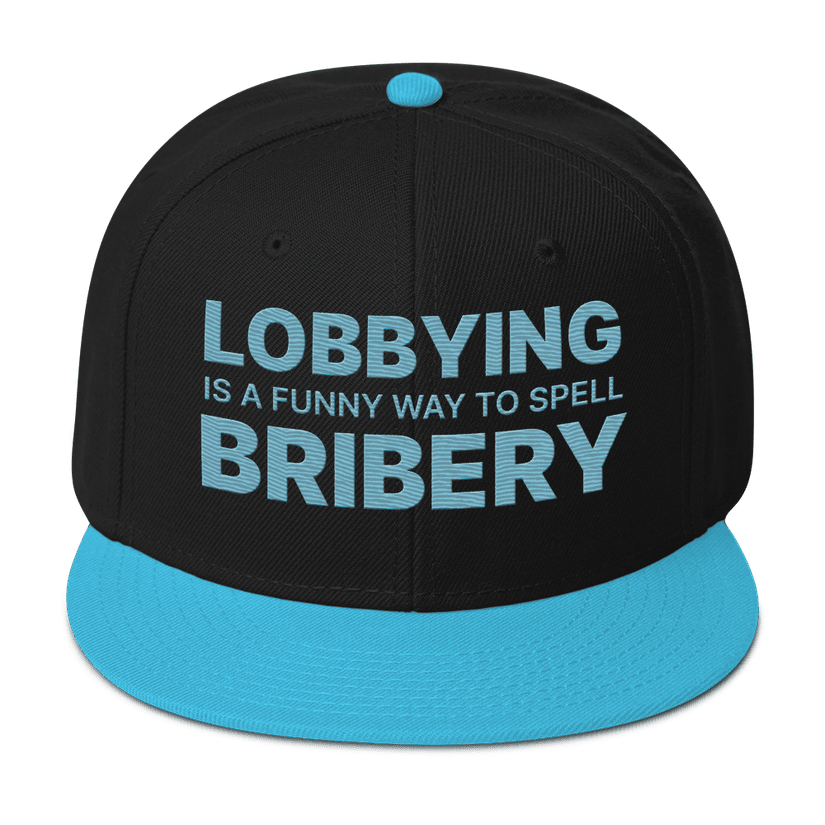
- Tropical. The tropical Lobbying / BRIBERY snapback, in a color meant to remind certain people of their offshore accounts.
Every hat is made on demand, and checkout happens on Printful.
Why Wear It at All
Paine wrote that "a long habit of not thinking a thing wrong, gives it a superficial appearance of being right." That is the whole condition of lobbying in America. We have lived with it so long it looks like weather.
A hat will not pass a law. But it starts conversations in grocery lines, airports, and town halls, where laws actually begin. Someone asks what it means. You tell them. They tell someone else. Paine closed that same passage with a line worth remembering: "Time makes more converts than reason." Give it time, and give it a little reason too.
On WeWrite we keep a page for this slogan, Lobbying is a funny way to spell Bribery, with its four colors, and a short note on lobbying.
Shop the Hat
Say it plainly. Pick your color of Lobbying is a funny way to spell BRIBERY:Black · Orange · Pink dad cap · TropicalMade on demand. Checkout on Printful.
Sources
- Thomas Paine, Common Sense (1776), Project Gutenberg: https://www.gutenberg.org/ebooks/147
- 18 U.S.C. § 201, Bribery of public officials and witnesses (Cornell LII): https://www.law.cornell.edu/uscode/text/18/201
- Lobbying Disclosure Act filings, Office of the Clerk, U.S. House: https://lobbyingdisclosure.house.gov/
- The Bill of Rights, transcript (National Archives): https://www.archives.gov/founding-docs/bill-of-rights-transcript
- The Federalist Papers, Nos. 51 and 57, Project Gutenberg: https://www.gutenberg.org/ebooks/1404
- George Washington, Farewell Address (1796), Avalon Project, Yale Law School: https://avalon.law.yale.edu/18th_century/washing.asp
Shop the hat
Black · Snapback
Lobbying is a funny way to spell BRIBERY
K Street won't like this one.
$33
View hatOrange · Snapback
Orange Lobbying / BRIBERY
Orange is the new Green.
$33
View hatPink · Dad cap
Pink Lobbying / BRIBERY dad cap
Bribery, dressed up.
$33
View hatTropical · Snapback
Tropical / blue Lobbying / BRIBERY
Flex on the lobbyists.
$33
View hat
Keep reading
November 7, 2026
What the Founders Said About Corruption
Madison, Hamilton, Jefferson and Washington on corruption, in their own verified words, and what their warnings ask of citizens today.
November 7, 2026
Neither Party Will Save You
Washington and Adams warned against two-party rule. Why New Continent opposes both major parties, and why your loyalty belongs to the people.
November 7, 2026
Why Americans Stopped Trusting Washington
Only 17% of Americans trust the federal government most of the time. Why trust collapsed under both parties, and what would earn it back.