The Case Against Lobbying, Made Plainly
A plain, founders-grounded case against the lobbying industry, from Federalist No. 10 to the revolving door. Not for either party. For the people.

There is a habit in our public life of making simple things sound complicated. The more complicated a thing sounds, the fewer people feel qualified to object to it. Lobbying is wrapped in this fog. It is called "advocacy," "government relations," "public affairs." Strip away the vocabulary and the matter is plain enough for any citizen to judge.
Paine opened his argument in Common Sense by asking only that the reader "divest himself of prejudice and prepossession, and suffer his reason and his feelings to determine for themselves." We ask the same.
First, What We Are Not Against
We are not against citizens speaking to their government. The First Amendment guarantees "the right of the people peaceably to assemble, and to petition the Government for a redress of grievances." A union hall that writes its senator, a church group that visits the statehouse, a veteran who testifies before a committee: these are the republic working as intended.
Our quarrel is with something narrower and larger at once: the permanent, professional industry of influence, where access is purchased by those who can afford it, and where the line between persuasion and payment grows fainter every year.

The Problem the Founders Named
James Madison understood this danger before the Constitution was ratified. In Federalist No. 10 he defined a faction as a group "united and actuated by some common impulse of passion, or of interest, adversed to the rights of other citizens, or to the permanent and aggregate interests of the community."
He then admitted the hard truth: "There are two methods of curing the mischiefs of faction: the one, by removing its causes; the other, by controlling its effects." Removing the cause, he said, would mean destroying liberty itself, a remedy "worse than the disease." So the work of a free people is to control the effects.
The professional lobbying industry is faction with a business model. It does not need to destroy liberty. It needs only to outlast the attention of everyone else. The citizen petitions once a year; the paid interest petitions every day.
Three Plain Objections
It is unequal. A republic rests on the idea, stated in the Declaration of Independence, that governments derive "their just powers from the consent of the governed." Consent is given by all of us equally, at the ballot box. Influence, once it becomes a profession, is distributed by wealth. That inequality does not appear in any law. It appears in whose calls are returned.
It is a door that swings both ways. Congress itself recognized the danger of officials cashing in on their public service. Federal law, at 18 U.S.C. § 207, bars a former Senator, "within 2 years after that person leaves office," from lobbying Congress on behalf of others, and imposes a one-year restriction on former House members. That Congress felt the need to write such a rule tells you the temptation is real. That the waiting period is so short tells you how seriously the temptation is taken.
It corrodes trust. Even where no law is broken, the appearance matters. When a citizen sees a bill shaped by those who fund campaigns, he draws a conclusion. He may be wrong in a particular case. But a republic in which the people assume their representatives are bought is already halfway lost, whatever the facts.
Why the Hat Says "Bribery"
We know the legal difference. The federal bribery statute, 18 U.S.C. § 201, requires that something of value be given "corruptly" to influence an official act. Lobbying is lawful, regulated, and reported.
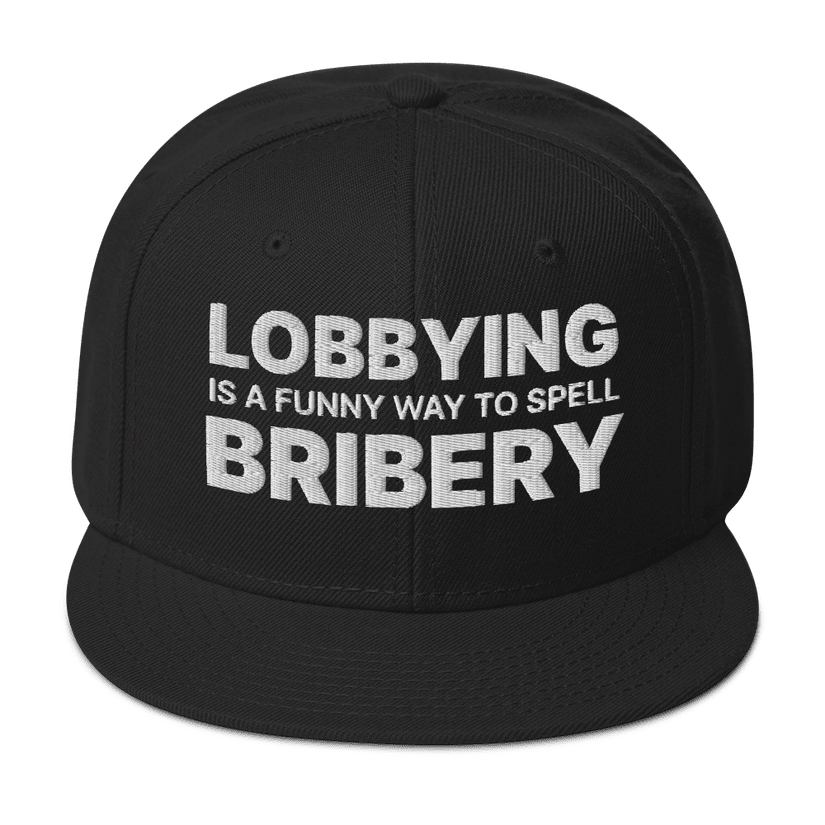
Our Lobbying is a funny way to spell BRIBERY snapback is a moral claim, not a legal one. It says that when lawful channels produce what would be scandalous if handed over in a single envelope, the problem is not the envelope. It is the law. We set out that case in full in Lobbying Is a Funny Way to Spell Bribery.

Against Both Houses
No party in America has refused the lobbyist's money. Both campaign on reform and govern on retainer. Our slogan is not a weapon to swing at your neighbor's team; it is a mirror to hold up to your own.
Washington warned in his Farewell Address that party spirit can make political combinations into "potent engines, by which cunning, ambitious, and unprincipled men will be enabled to subvert the power of the people." The lobbying trade is one such engine, and it runs on both parties' fuel.

What a Citizen Can Do
The remedy Madison proposed was not despair. It was structure: rules that set ambition against ambition. We cover concrete, real reforms in How to Get Money Out of Politics. For today, start smaller:
- Look up who lobbies. Lobbying Disclosure Act filings are public through the House Clerk and the Senate.
- Ask your representatives directly which interests they meet with, and whether they will support longer revolving-door bans.
- Say it out loud. Many people agree with you and are waiting for someone to go first.
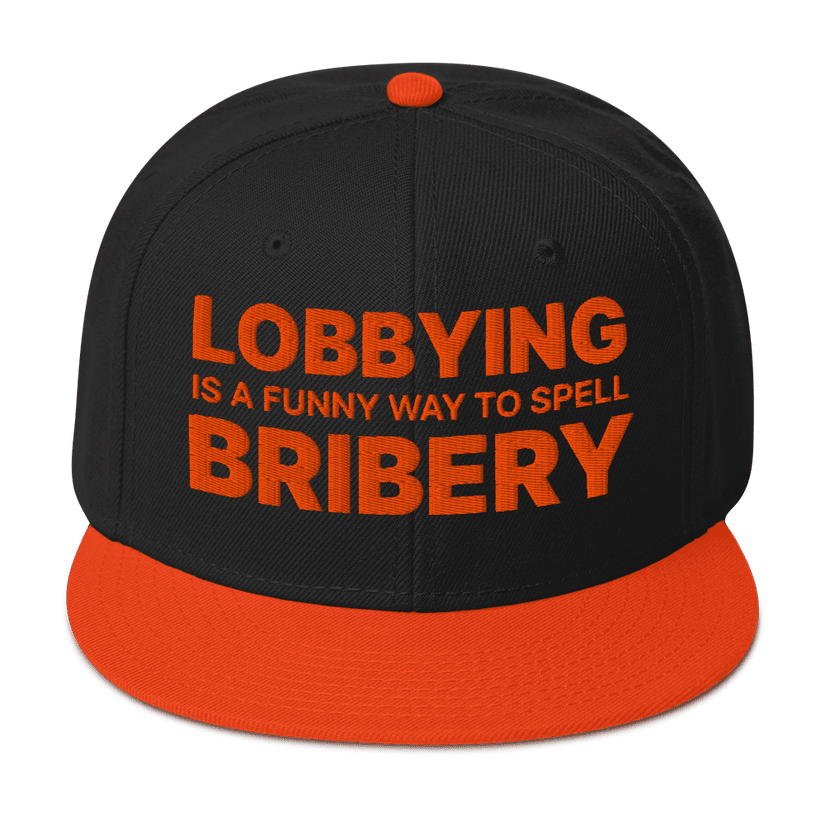
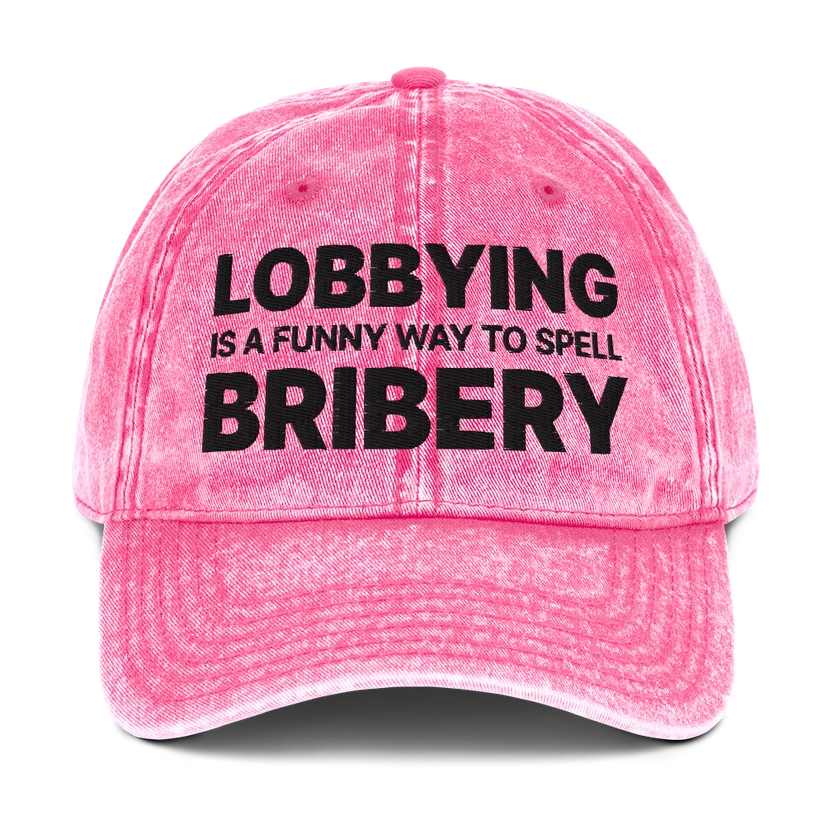
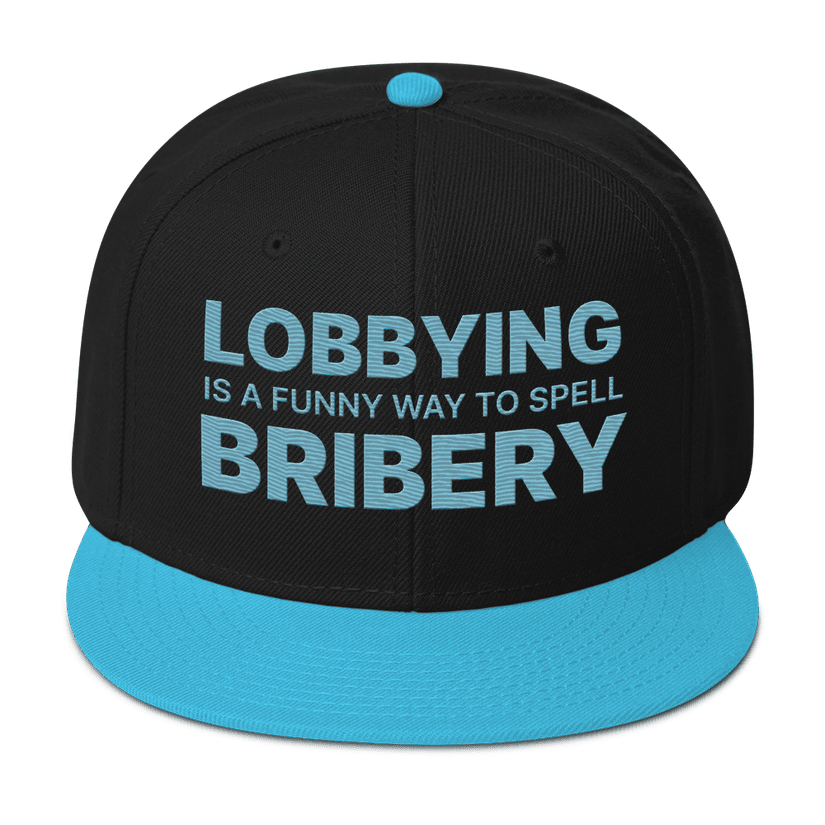
That last one is where a hat comes in. The orange, pink dad cap, and tropical colorways carry the same message as the black. Choose whichever color you'll actually wear.
On WeWrite we keep short pages on lobbying and on the slogan itself, Lobbying is a funny way to spell Bribery.
Shop the Hat
Wear the argument. Lobbying is a funny way to spell BRIBERY, in four colors:Black · Orange · Pink dad cap · TropicalMade on demand. Checkout on Printful.
Sources
- Thomas Paine, Common Sense (1776), Project Gutenberg: https://www.gutenberg.org/ebooks/147
- The Federalist Papers, No. 10, Project Gutenberg: https://www.gutenberg.org/ebooks/1404
- Declaration of Independence, transcript (National Archives): https://www.archives.gov/founding-docs/declaration-transcript
- The Bill of Rights, transcript (National Archives): https://www.archives.gov/founding-docs/bill-of-rights-transcript
- 18 U.S.C. § 207, Restrictions on former officers and elected officials (Cornell LII): https://www.law.cornell.edu/uscode/text/18/207
- 18 U.S.C. § 201, Bribery of public officials (Cornell LII): https://www.law.cornell.edu/uscode/text/18/201
- George Washington, Farewell Address (1796), Avalon Project: https://avalon.law.yale.edu/18th_century/washing.asp
- Lobbying Disclosure, Office of the Clerk, U.S. House: https://lobbyingdisclosure.house.gov/
Shop the hat
Black · Snapback
Lobbying is a funny way to spell BRIBERY
K Street won't like this one.
$33
View hatOrange · Snapback
Orange Lobbying / BRIBERY
Orange is the new Green.
$33
View hatPink · Dad cap
Pink Lobbying / BRIBERY dad cap
Bribery, dressed up.
$33
View hatTropical · Snapback
Tropical / blue Lobbying / BRIBERY
Flex on the lobbyists.
$33
View hat
Keep reading
November 7, 2026
Lobbying Is a Funny Way to Spell Bribery
Why we call lobbying a funny way to spell bribery, what the law says, and why the founders would wear the hat. A plain case for citizens.
November 7, 2026
How to Get Money Out of Politics
Real, existing reforms to get money out of politics: revolving-door limits, small-donor public financing, disclosure, and foreign-money enforcement.
November 7, 2026
Why Americans Stopped Trusting Washington
Only 17% of Americans trust the federal government most of the time. Why trust collapsed under both parties, and what would earn it back.