Congress Shouldn't Be Trading Stocks
Members of Congress write the rules for industries and trade their stocks. What the STOCK Act does, why it isn't enough, and what a real ban looks like.

Most Americans never get a classified briefing. They don't sit in closed-door hearings with the heads of drug companies, defense contractors, and banks. They don't help write the rules that decide which industries win next year. Members of Congress do all three. Many of them also buy and sell individual stocks.
That is the whole problem, and you don't need a finance degree to see it.
The Law We Already Have
In 2012, Congress passed the Stop Trading on Congressional Knowledge Act, the STOCK Act. It says members can't use nonpublic information from their jobs to trade, and it requires them to report trades by themselves, their spouses, and their dependent children within 45 days. The idea was sunlight. If the trades are public, the reasoning went, nobody will dare to cheat.
The sunlight turned out to be dim. In its "Conflicted Congress" investigation, Business Insider and other outlets identified 78 members of Congress who had failed to report their trades on time as the law requires. Those were Democrats and Republicans, leaders and back-benchers. The excuses ranged from "my accountant missed it" to "I didn't know."
The typical penalty for a late filing is a $200 fee. Reporting on the law has pointed out the same thing again and again: the fine is so small that it works more like a filing charge than a punishment. A citizen who misses a tax deadline usually pays more than that.

It's Not About Proving a Crime
Defenders of the current system like to say there's no proof any particular member traded on inside knowledge. Sometimes that's true. It's also beside the point.
We don't let judges hear cases where they own stock in one of the parties. We don't let a referee bet on the game. We don't ask them to promise they'll be fair anyway. We take the conflict away, because a conflict corrodes trust whether or not anyone acts on it.
The founders understood this. In Federalist No. 10, James Madison wrote that "no man is allowed to be a judge in his own cause, because his interest would certainly bias his judgment, and, not improbably, corrupt his integrity." A lawmaker who writes the rules for an industry while holding its shares is a judge in his own cause. That was a problem in 1787. It still is.
Both Parties Like It This Way
This isn't a left or right issue, and that is exactly why it hasn't been fixed. Bills to ban individual stock trading by members have been introduced again and again, with sponsors from both parties. Some have bipartisan backing in public. They tend to stall where the leaders decide what comes to the floor.
When a reform has support from voters in both parties and still can't get a vote, ask who benefits from the delay. The answer is the people who would have to give something up. That's the pattern we write about in Neither Party Will Save You: the two parties fight loudly about almost everything, and quietly agree about the things that protect the club.

What a Real Fix Looks Like
A real fix is simple enough to fit on a hat.
- Ban individual stock trading by members of Congress, their spouses, and dependent children while they serve.
- Allow broad funds. Diversified mutual funds, index funds, Treasury bills, and the federal Thrift Savings Plan don't let anyone bet on a single company's fate.
- Use a blind trust or divest. New members get a fixed window to sell or move holdings into a truly blind trust.
- Make penalties hurt. Forfeit the profits to the Treasury and add real fines. A $200 fee isn't a deterrent.
- Audit it. An ethics office should check compliance on a schedule, not wait for reporters to do it.
None of this stops a member of Congress from saving for retirement. It just stops them from doing it in a way that invites the question every one of their constituents is already asking.
The Smell Test
Here's the plain version. If a stranger asked you whether people who write laws for companies should be allowed to bet on those companies, you'd say no before they finished the sentence. Most Americans would. The only people who need a long explanation are the ones who benefit.
That's why we keep saying the same thing about influence in Washington: when something needs a lawyer to explain why it isn't corruption, ordinary people have a right to ask why it's allowed at all. We made that case about lobbying in Lobbying Is a Funny Way to Spell Bribery. Stock trading by lawmakers is the same story with a brokerage app.
What You Can Do This Week
You don't have to wait for Congress to grow a conscience.
- Look up your own members. Their periodic transaction reports are public on the House Clerk and Senate disclosure sites. Search their names and see what they trade.
- Ask a direct question. Call or write their office and ask one thing: will you support a ban on individual stock trading by members and their spouses, yes or no? Write down the answer.
- Ask candidates too. Challengers in primaries are often willing to commit to this in writing. Get it on the record before they're in the club.
- Talk about it out loud. Nothing changes in Washington until it becomes embarrassing at the kitchen table.
We started New Continent because we think the country belongs to the people who live in it, not to whoever has the best seat at the briefing. You can read more about why on our WeWrite page.
Wear the Question
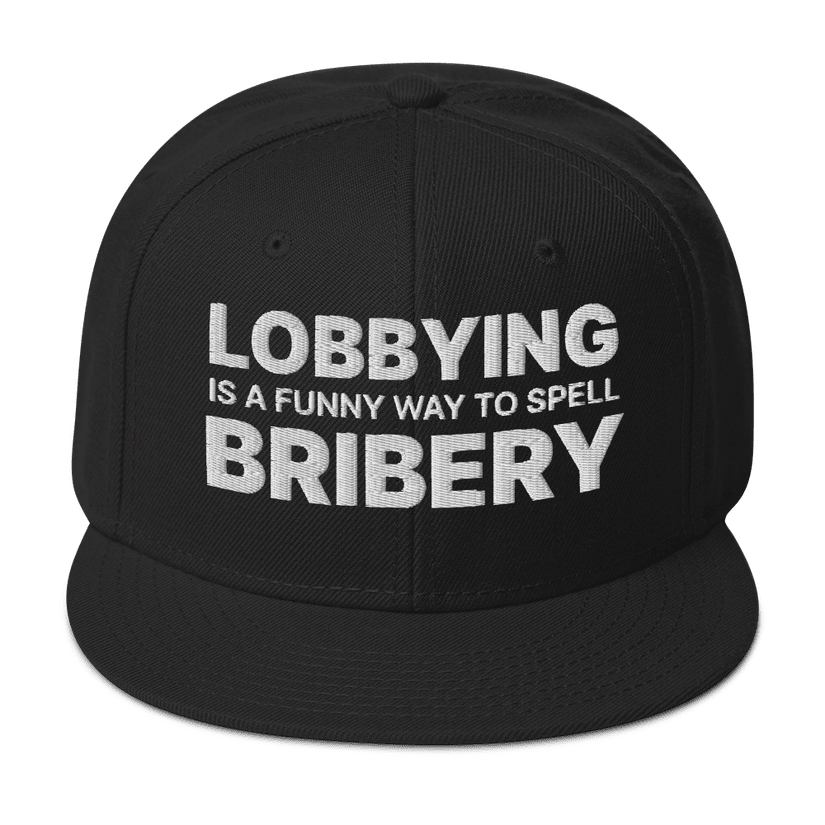
A hat won't pass a stock-trading ban. But it starts the conversation in line at the coffee shop and at the gate at the airport, and that's where pressure starts. Our black cap says what plenty of people are thinking about how Washington works: Lobbying is a funny way to spell BRIBERY. When someone asks what it means, tell them about the $200 fee.
On WeWrite we keep a short page for that slogan, Lobbying is a funny way to spell Bribery.
Shop the Hat
Say it plainly. Lobbying is a funny way to spell BRIBERY, black snapbackMade on demand. Checkout on Printful.
Sources
- Dave Levinthal and Madison Hall, "78 members of Congress have violated a law designed to prevent insider trading and stop conflicts-of-interest," Business Insider: https://www.businessinsider.com/congress-stock-act-violations-senate-house-trading-2021-9
- Stop Trading on Congressional Knowledge Act of 2012, Public Law 112-105 (Congress.gov): https://www.congress.gov/bill/112th-congress/senate-bill/2038
- James Madison, Federalist No. 10 (1787), Avalon Project, Yale Law School: https://avalon.law.yale.edu/18th_century/fed10.asp
- "Lawmakers Violate the STOCK Act All the Time. Why Doesn't Anyone Care?" (Yahoo Finance), on the $200 late-filing fee: https://finance.yahoo.com/news/lawmakers-violate-stock-act-time-184016648.html
- House financial disclosure reports, Office of the Clerk: https://disclosures-clerk.house.gov/
- Senate financial disclosures: https://efdsearch.senate.gov/
Shop the hat
Keep reading
November 7, 2026
Why Americans Stopped Trusting Washington
Only 17% of Americans trust the federal government most of the time. Why trust collapsed under both parties, and what would earn it back.
November 7, 2026
The Right to Petition: Lobbying Was Supposed to Be Yours
The First Amendment protects your right to petition the government. How it got professionalized, and how ordinary citizens can use it well.
November 7, 2026
The Elections Nobody Shows Up For
In some big cities, fewer than 1 in 10 people vote for mayor. Why local elections matter more than you think, and a simple plan to show up.