Why Ban AIPAC? Foreign Lobbying and Self-Government
What AIPAC is and how it operates, from FEC and lobbying records, and a principled case against foreign-interest lobbying for every country.

This is a subject on which tempers run hot, so we will proceed slowly and with sources. Our argument is about policy and about how influence works in Washington. It is not about any people, faith, or heritage, and anyone who turns it into that has abandoned our argument, not extended it. We apply the same principle to every country on earth.

A Principle Older Than Any Lobby
George Washington spent much of his Farewell Address on one danger. "Against the insidious wiles of foreign influence (I conjure you to believe me, fellow-citizens)," he wrote, "the jealousy of a free people ought to be constantly awake, since history and experience prove that foreign influence is one of the most baneful foes of republican government."
He went further, and the passage applies to every alliance America has ever held: "The nation which indulges towards another a habitual hatred or a habitual fondness is in some degree a slave. It is a slave to its animosity or to its affection, either of which is sufficient to lead it astray from its duty and its interest."
And he added the line that governs this whole post: "But that jealousy to be useful must be impartial; else it becomes the instrument of the very influence to be avoided."
Impartial. Our objection is not to one country. It is to any organized effort to bend American policy toward the interests of another nation, whoever that nation is.
What AIPAC Is, From the Record
The American Israel Public Affairs Committee describes itself on its website as "an American grassroots organization that works to strengthen the U.S.-Israel partnership," whose mission is "to encourage and persuade the U.S. government to enact specific policies that create a strong, enduring and mutually beneficial relationship with our ally Israel." It states that it "is funded exclusively by Americans."
Here is what the public record shows about how it operates:
- It lobbies Congress as a registered domestic lobbying organization. AIPAC appears as a registrant in the Lobbying Disclosure Act database maintained by the Clerk of the House, listing itself as its own client.
- It is not registered under the Foreign Agents Registration Act. FARA, enacted in 1938, requires certain agents of foreign principals engaged in political activities to publicly disclose that relationship and their related spending, according to the Department of Justice. As of Nov. 4, 2026, the Justice Department's public FARA registrant lists (active and terminated) contain no entry for the American Israel Public Affairs Committee. That absence is a fact about the register, not a legal ruling: FARA covers people acting at the direction or control of a foreign principal, and AIPAC says it is American-funded and files instead under the Lobbying Disclosure Act.
- It runs a PAC and a super PAC. For most of its history AIPAC did not give money to candidates. FactCheck.org reports that AIPAC announced in December 2021 that it would launch a PAC and a super PAC; AIPAC PAC was created December 15, 2021, and its super PAC, the United Democracy Project, was established January 3, 2022. The FEC lists United Democracy Project as an independent-expenditure-only committee (a super PAC), ID C00799031.
- That super PAC spends heavily. Using FEC data, OpenSecrets reports that United Democracy Project spent $37,860,200 in independent expenditures in the 2024 cycle (figures checked Nov. 4, 2026; OpenSecrets cites FEC data released March 19, 2025): $14,067,863 supporting Democrats, $20,786,780 opposing Democrats, and $3,043,662 opposing Republicans.
Those figures are public, and we encourage every reader to check them at the links below.

The Gap in the Law
Here is the heart of our argument. American law treats foreign influence in two very different ways.
Foreign money in elections is flatly banned. Under 52 U.S.C. § 30121, it is "unlawful for" a foreign national "directly or indirectly" to make a contribution or donation "in connection with a Federal, State, or local election."
Foreign agents must register under FARA and disclose their relationship with the foreign principal, along with related receipts and spending. Those filings are made with the Department of Justice and are public.
But a domestic organization, funded by Americans, may lawfully devote itself to advancing the interests of a particular foreign country, lobby Congress for that purpose, and spend tens of millions of dollars in our elections, all without registering as a foreign agent. AIPAC is the most prominent example. It is not the only one, and our principle reaches all of them.
Nothing in this is illegal under current law. That is precisely our complaint. Washington asked that our jealousy of foreign influence be "constantly awake." The law, as written, keeps it awake only when a foreign hand is visibly on the money.
What "Ban" Means to Us
A hat is short. An argument is longer. When we say BAN AIPAC, we mean a policy position that would apply to every country:
- No organized lobbying or campaign spending whose central purpose is advancing a particular foreign government's policy interests, whether funded from abroad or at home, and whichever country it serves.
- Until then, full sunlight. Reformers have argued for broader disclosure rules and stronger FARA enforcement. We support anything that tells the public plainly whose interests are being represented.
We recognize that reasonable people disagree on where the legal line should fall, and that the First Amendment protects "the right of the people peaceably to assemble, and to petition the Government." Americans of every background may hold strong views on foreign policy and press them as citizens. Our concern is with the professional, well-funded machinery of influence built around one nation's interests, any nation's.

Neither Party Is Exempt
The OpenSecrets figures above show spending in races of both parties. Members of both parties have welcomed foreign-policy lobbies of many kinds. This is not a left issue or a right issue. It is a self-government issue, and both parties have a stake in it. We explain why we trust neither in Neither Party Will Save You, and lay out broader reforms in How to Get Money Out of Politics.
The Hat
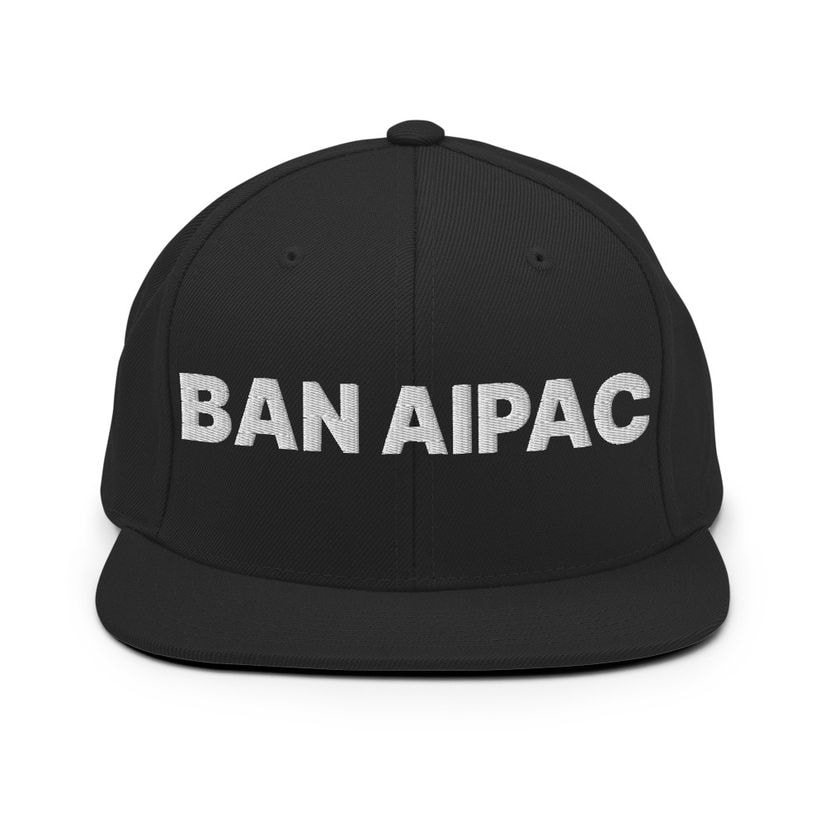
Our BAN AIPAC black snapback is, in the words of its product page, "a bold stand against foreign influence in American politics" for "those who believe our government should answer to the people, not to lobbyists."
Wear it as Washington would have wanted: impartially. If someone asks you about it, tell them the principle, and tell them it applies to every country.
Shop the Hat
Our government answers to the people.BAN AIPAC, black snapbackMade on demand. Checkout on Printful.
Sources
- George Washington, Farewell Address (1796), Avalon Project: https://avalon.law.yale.edu/18th_century/washing.asp
- AIPAC, About: https://www.aipac.org/about
- Lobbying Disclosure Act registrant record, American Israel Public Affairs Committee (Office of the Clerk, U.S. House): https://lobbyingdisclosure.house.gov/lookup.asp?reg_id=31095
- Foreign Agents Registration Act, U.S. Department of Justice: https://www.justice.gov/nsd-fara
- FARA eFile registrant lists, active and terminated (DOJ), checked Nov. 4, 2026: https://efile.fara.gov/ords/fara/f?p=1381:1
- FactCheck.org, "United Democracy Project" (2024): https://www.factcheck.org/2024/09/united-democracy-project-2/
- FEC committee profile, United Democracy Project, C00799031: https://www.fec.gov/data/committee/C00799031/
- OpenSecrets, United Democracy Project outside spending, 2024 (checked Nov. 4, 2026): https://www.opensecrets.org/outside-spending/detail/2024?cmte=C00799031
- 52 U.S.C. § 30121 (Cornell LII): https://www.law.cornell.edu/uscode/text/52/30121
- The Bill of Rights, transcript (National Archives): https://www.archives.gov/founding-docs/bill-of-rights-transcript
Shop the hat
Keep reading
November 7, 2026
Neither Party Will Save You
Washington and Adams warned against two-party rule. Why New Continent opposes both major parties, and why your loyalty belongs to the people.
November 7, 2026
How to Get Money Out of Politics
Real, existing reforms to get money out of politics: revolving-door limits, small-donor public financing, disclosure, and foreign-money enforcement.
November 7, 2026
Why Americans Stopped Trusting Washington
Only 17% of Americans trust the federal government most of the time. Why trust collapsed under both parties, and what would earn it back.